BMFTR Research Group DAVIF

Searching for Lotte Reiniger

A scrollytelling data visualization for the BMFTR Research Group "Aesthetics of Access. Visualizing Research Data on Women in Film History" (DAVIF), turning film-historical metadata gaps into a public argument about whose work gets counted, and whose disappears.
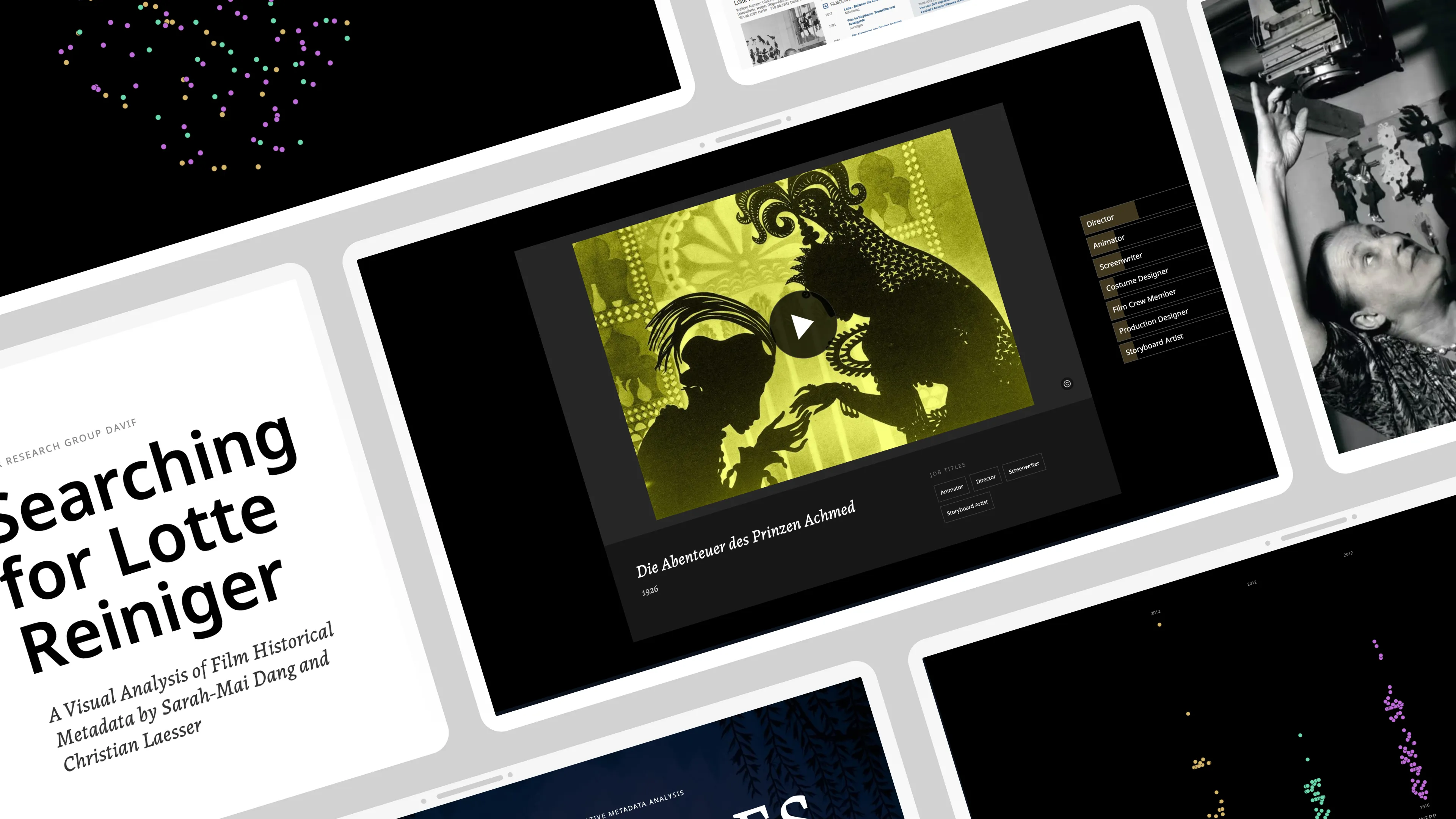
Searching for Lotte Reiniger
"Collaborating with Christian was a fantastic experience. He has a great ability to turn complex research and archival material into engaging data visualizations and digital storytelling. His prototypes provided clarity early in the process and helped shape the direction of the project with curiosity and creativity. Bringing theoretical and practical expertise into a productive dialogue is often difficult to achieve in interdisciplinary projects, which made this collaboration particularly rewarding."
— Dr. Sarah-Mai Dang, Principal Investigator, BMFTR Research Group DAVIF

Challenge

The BMFTR Research Group DAVIF at Philipps-Universität Marburg had spent four years investigating how film-historical metadata shapes our understanding of women in early cinema. By the project’s end, the team had published several publications, in addition to building two data visualization tools and assembling three datasets from Wikidata, the DFF Deutsches Filminstitut & Filmmuseum, and the Women Film Pioneers Project. The research question was clear and the data was there. What the project needed next was a thematic focus, a narrative form, and a collaborator willing to work conceptually rather than just execute. The brief was deliberately open: a standing invitation to help shape what the final output could be.

Solution

The result is a scrollytelling website co-authored with Sarah-Mai Dang, whose research in feminist film historiography and critical data studies forms the conceptual foundation of the work. Together, the project uses a single figure, Lotte Reiniger, the director of the world's first full-length animated feature film, as a lens for examining what databases choose to record and what they leave out. Three interconnected visualization sections guide the reader through her films, the gaps between datasets, and the inconsistency in how her professional roles are categorized. Crucially, the site shows her actual work alongside the metadata, animated silhouette films rendered on screen, so that the missing data registers as a genuine absence, not an abstract statistic. The site was designed and built in SvelteKit, with Canvas-based animations and D3 for the interactive charts.

My Contribution

This was a collaboration on equal footing. Sarah-Mai Dang contributed the research methodology, theoretical framework, editorial direction, textual content, data co-curation, academic analysis, and validation that gave the project its intellectual backbone. I contributed data normalization, narrative concept development, visual design, and frontend development, translating the research into a scrollytelling website built in SvelteKit with Canvas animations and D3.
  • Client

    BMFTR Research Group DAVIF

  • My Role
    Data Visualization
    Web Design
    Frontend Development
  • Time

    2025–2026

  • Collaboration

    Dr. Sarah-Mai Dang (Principal investigator, co-author, research methodology, editorial direction, and academic analysis)

  • Funding

    German Federal Ministry of Research, Technology and Space (BMFTR)

Results
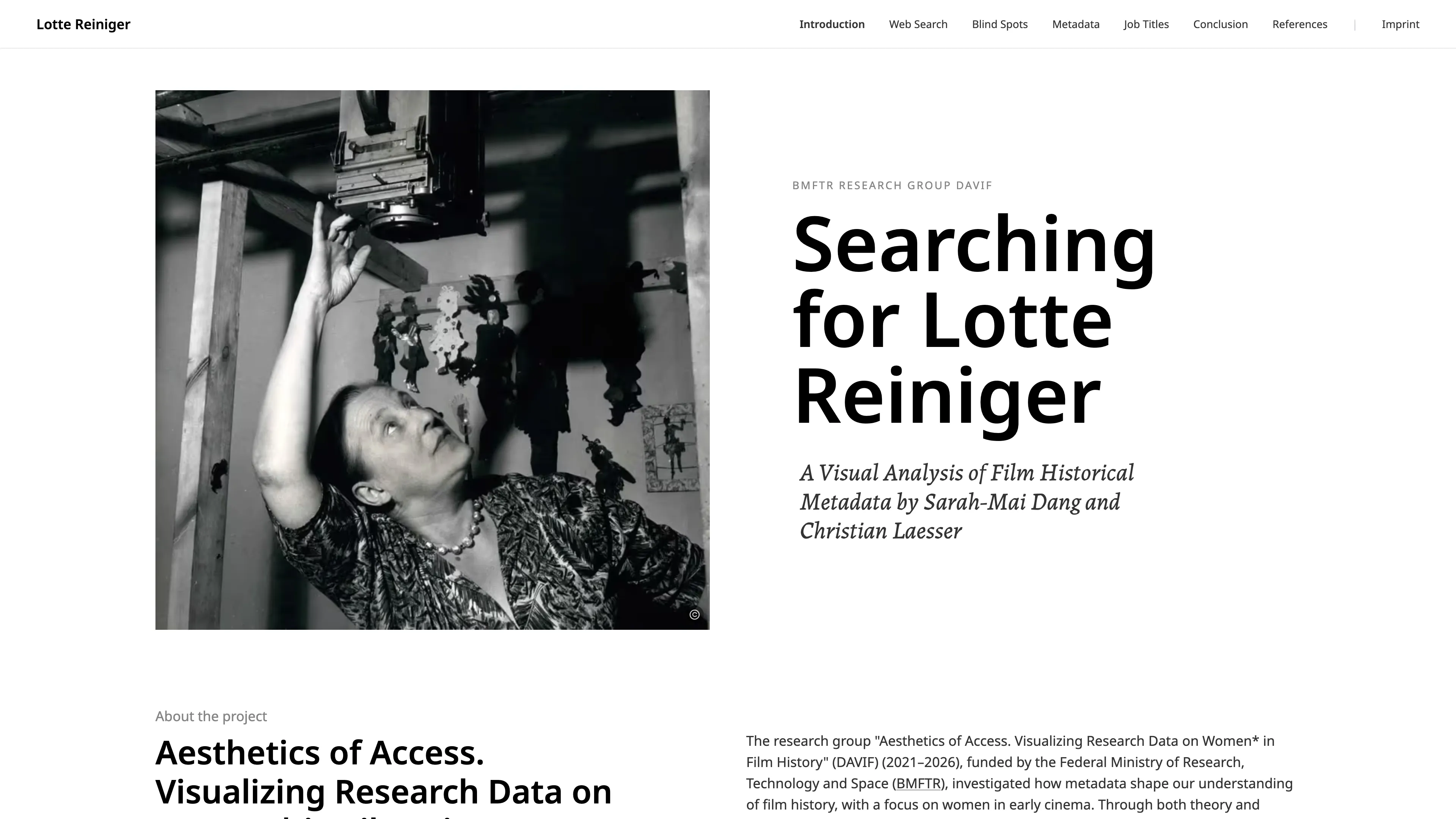
Project start page
Project start page
The opening screen introduces Lotte Reiniger through a portrait and subtitle that frames the project as a visual analysis rather than a conventional academic publication. The navigation structure signals the scrollytelling approach from the first moment.
Scrollytelling — movies with timeline and profession bars
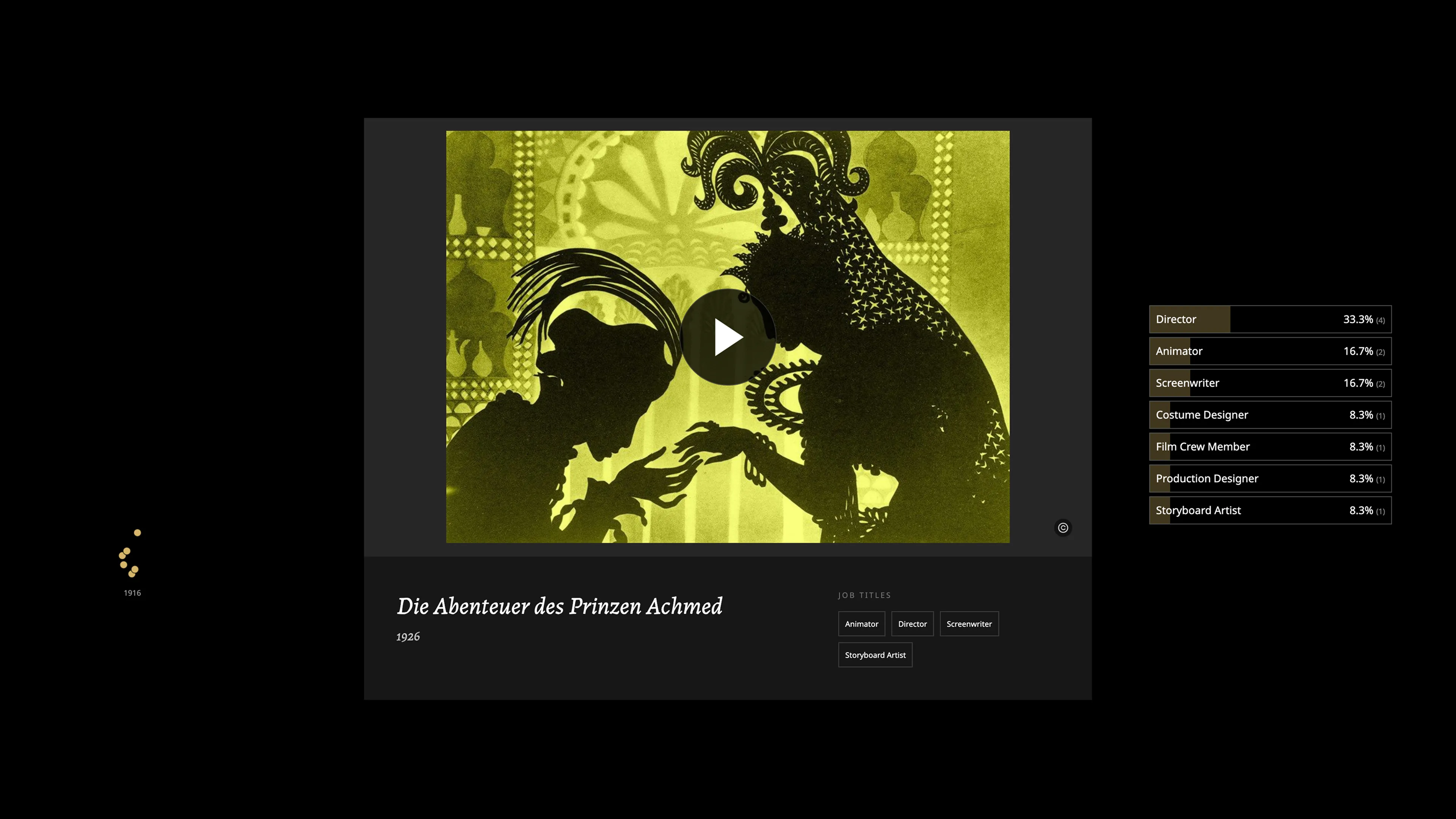
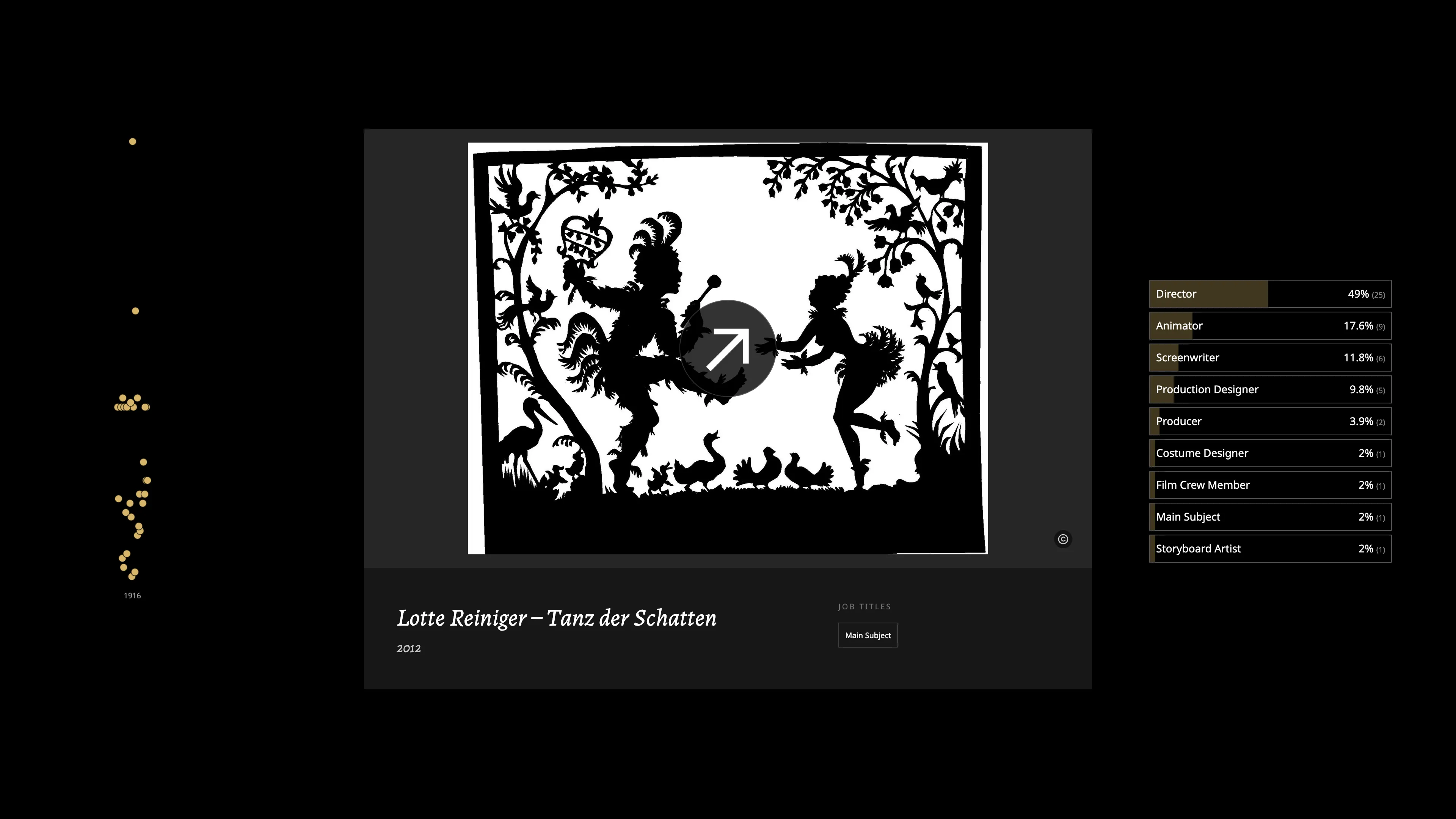
The first scrollytelling section builds two parallel visualizations as the reader scrolls through each of Reiniger's films: a timeline on the left and a profession distribution on the right. The canvas animation shows actual frames and titles from her work, making the weight of each missing film felt rather than merely counted.
Movies — a note about the nazi era
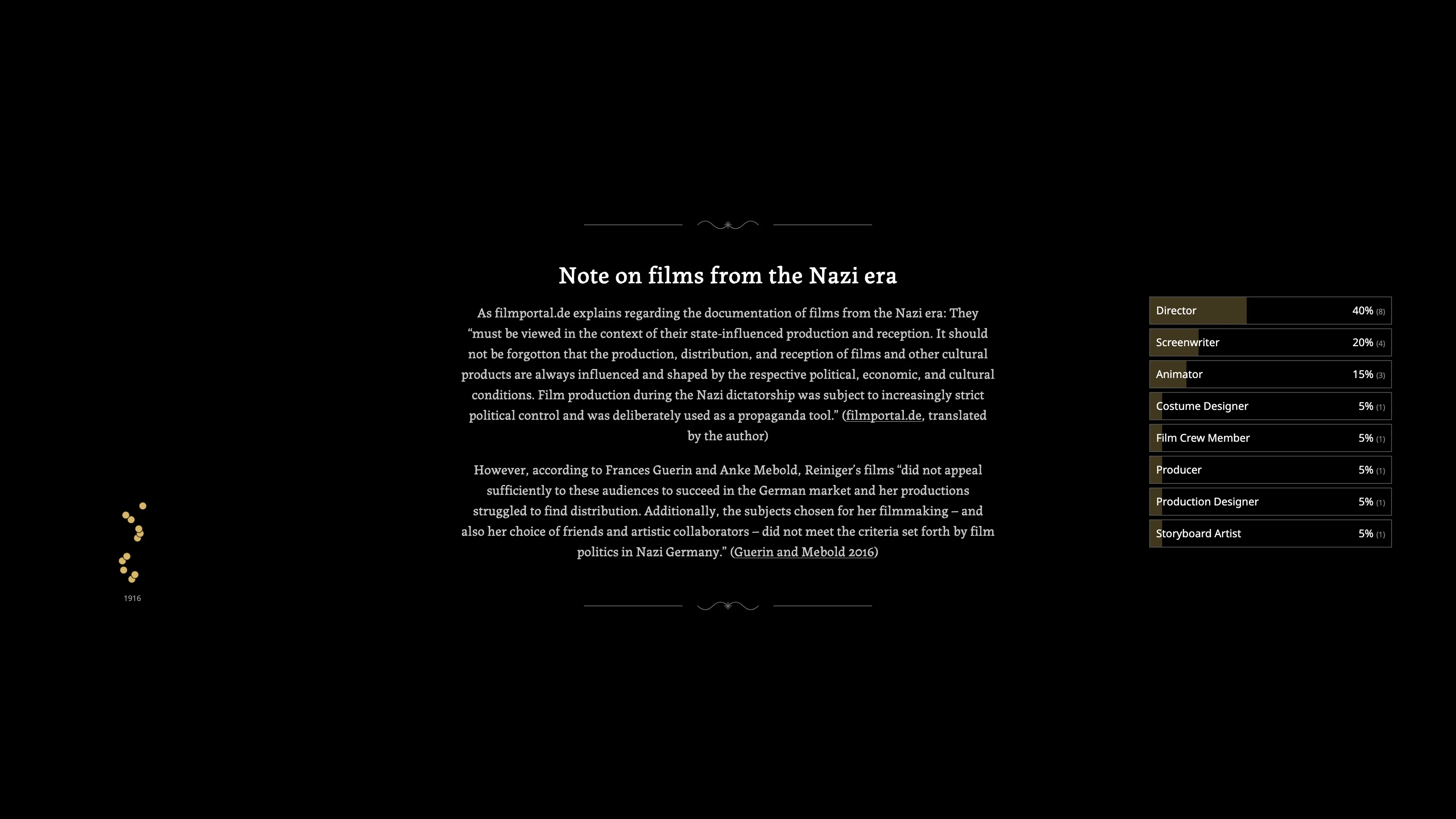
As the reader scrolls through the films, one of many notes appears in the visual language of silent-era title cards: contextualizing Reiniger's output during the Nazi period. Her films did not serve the propaganda purposes of the regime, and her choice of subjects and collaborators placed her outside the criteria of Nazi film politics. The note is part of the editorial honesty the project holds itself to throughout.
Movies — further visual exploration
Each film in the scroll is presented with its own visual character, drawn from the actual footage and stills. The sequence is an argument for the breadth and distinctiveness of Reiniger's practice across four decades — before the metadata analysis begins to measure how much of that practice the databases have captured.
Beeswarm — film coverage across three databases
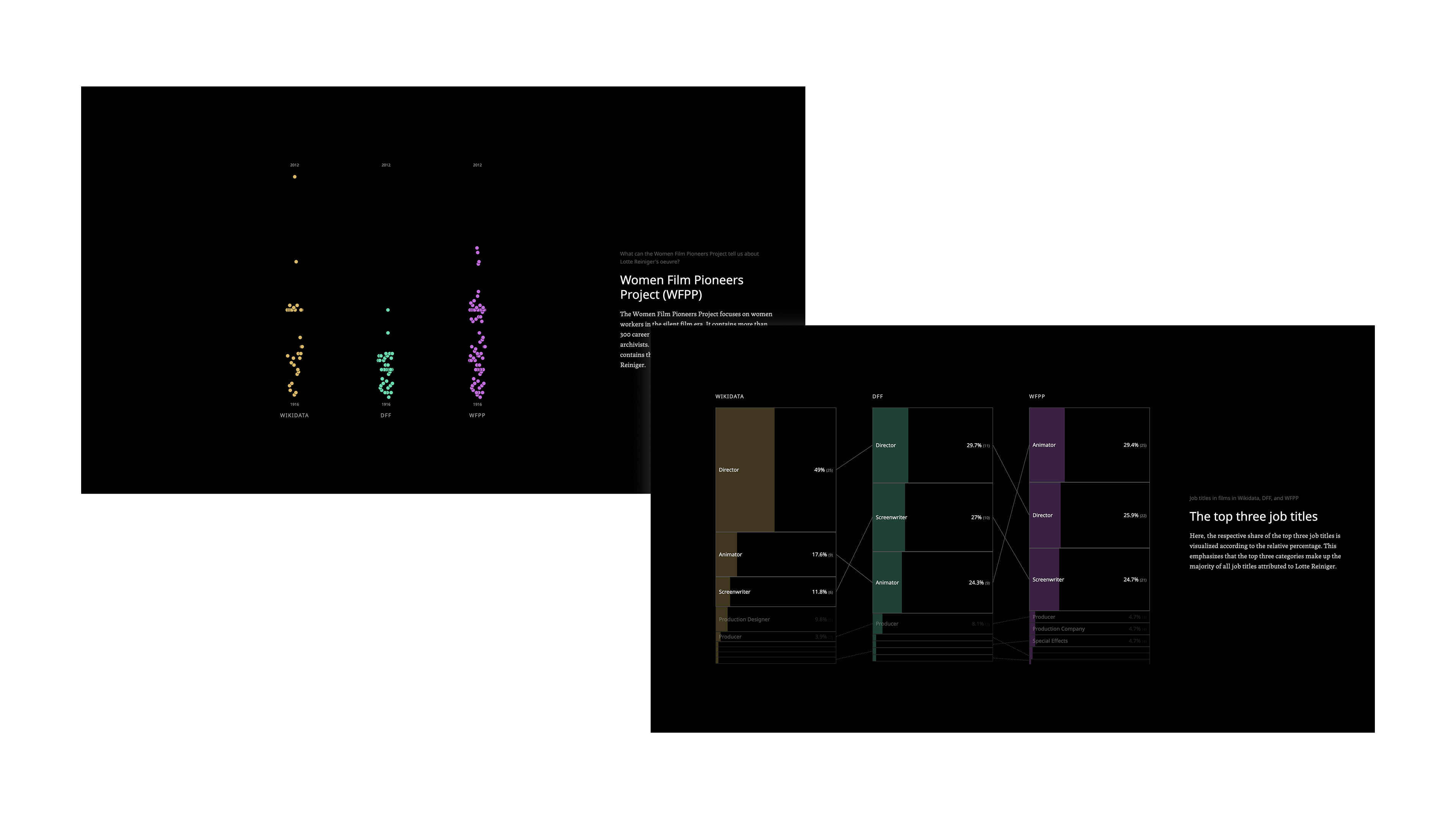
The second section opens by showing what the Wikidata dataset alone knows about Reiniger. Each dot is a film. The visualization makes the scale of the collection immediately readable before introducing the fuller datasets for comparison.
Beeswarm — films shared across datasets
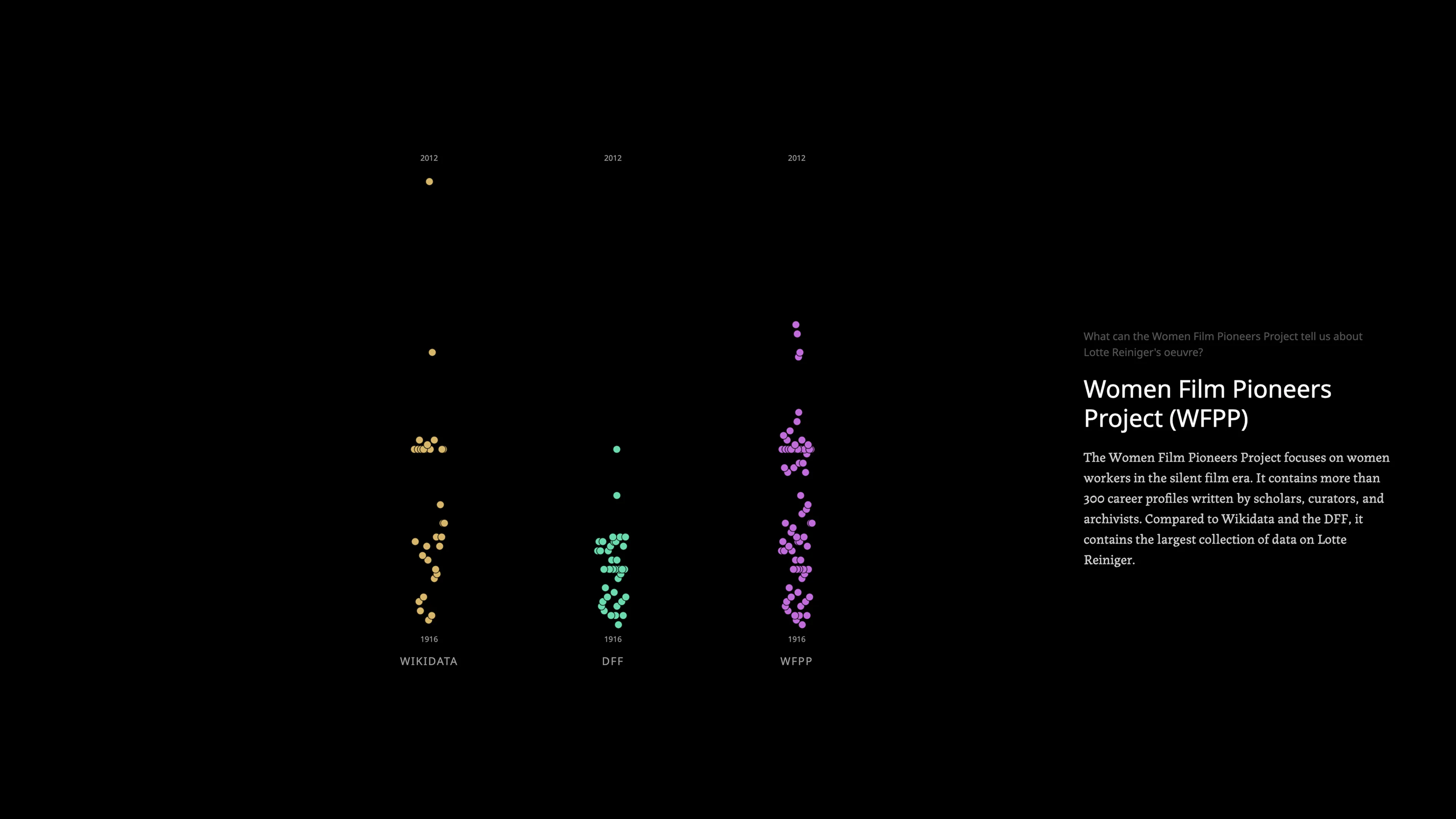
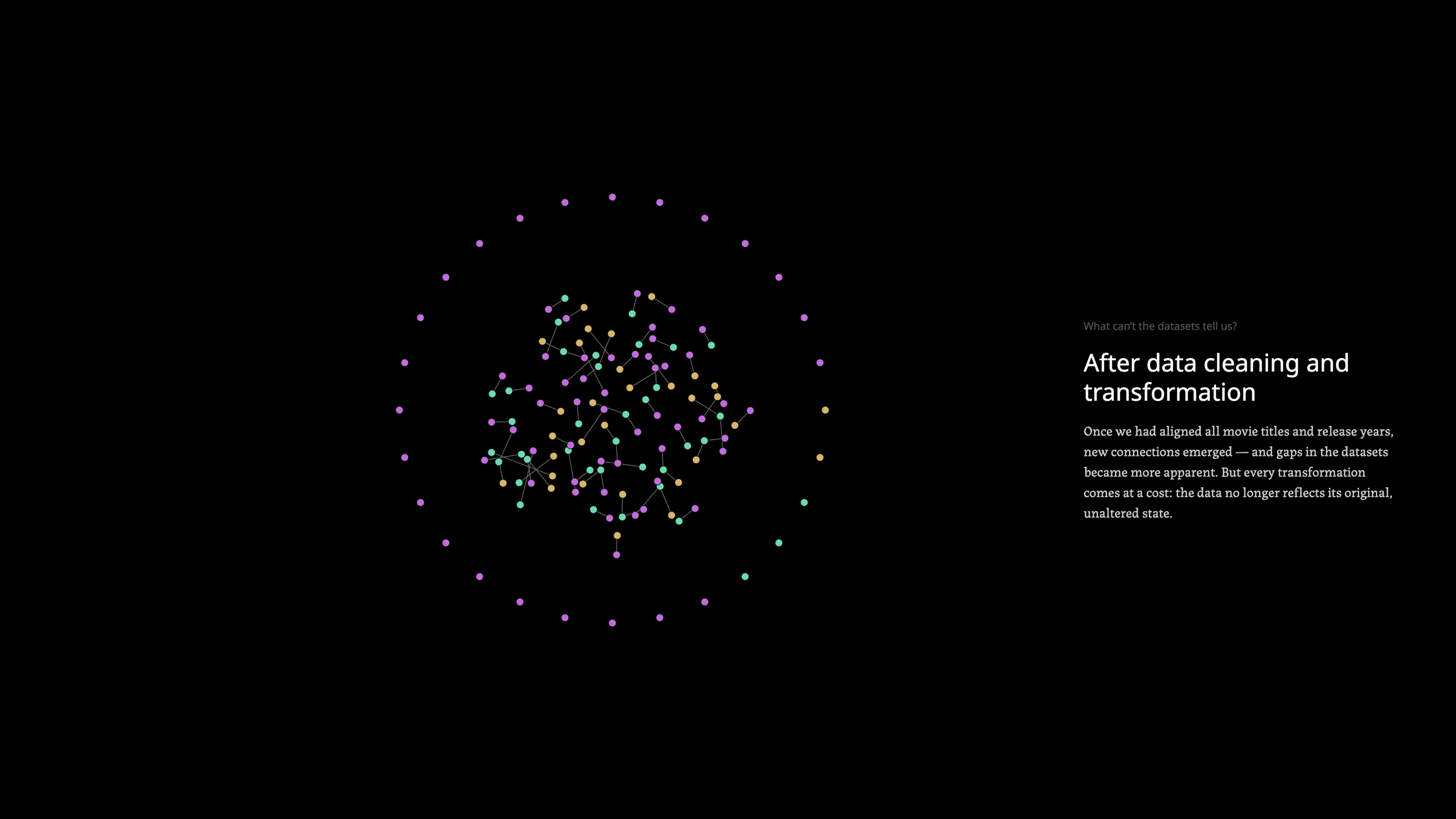
After normalizing and cross-referencing all three datasets, this view shows only the films that appear in more than one source: the shared record. The data normalization required to make this comparison was itself a significant research contribution.
Beeswarm — films missing from Wikidata
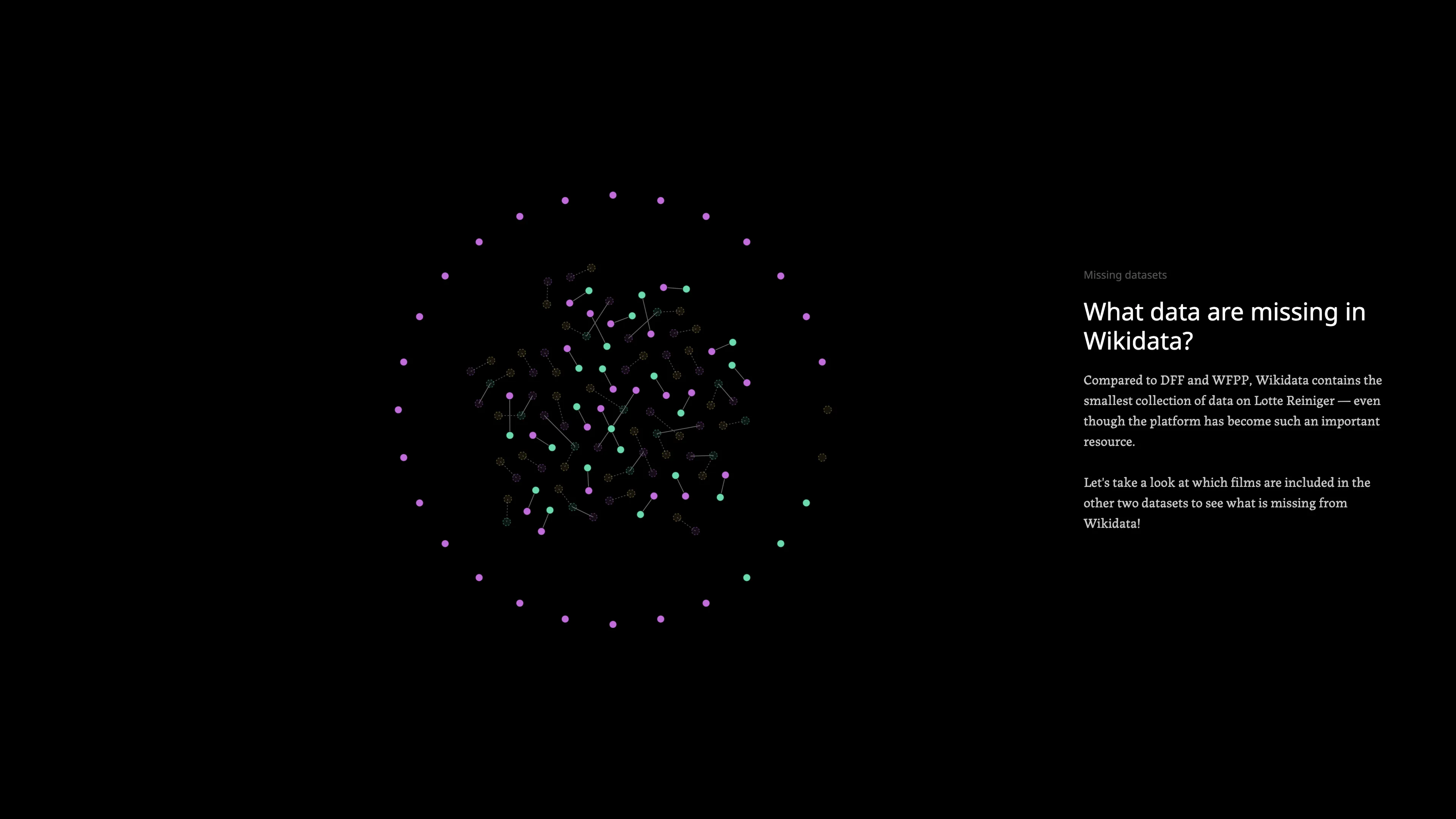
The same beeswarm encodes what Wikidata does not have: films documented by the DFF or WFPP that the world's most-consulted open database has never recorded. The gap between the full filmography and the Wikidata subset is the argument.
Bar chart — job title distribution in Wikidata
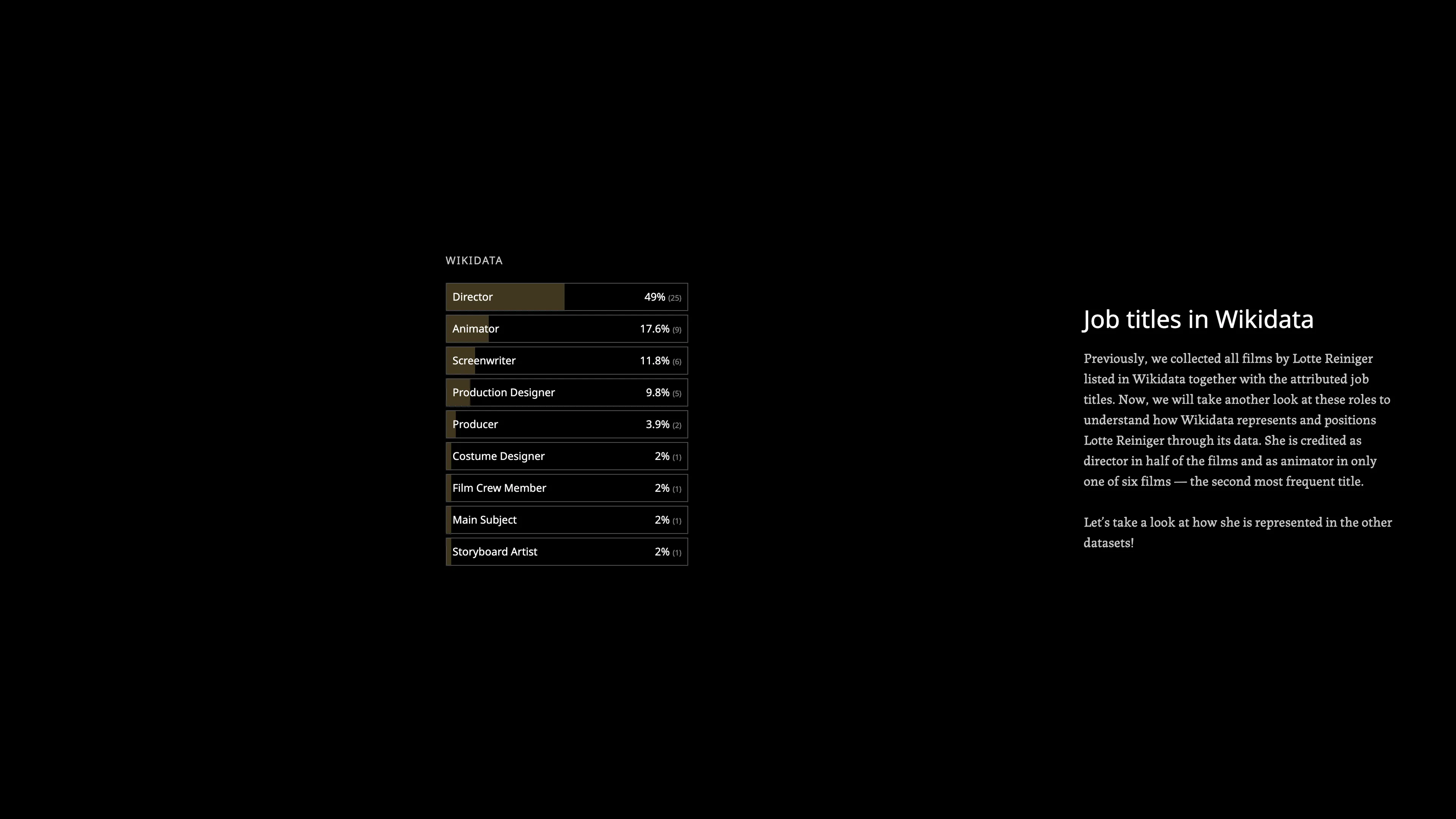
The third section opens with Wikidata's categorization of Reiniger's professional roles. The chart makes it possible to see how a single database constructs a professional identity, before that picture is complicated by the other sources.
Bar chart — job title distribution across all three datasets
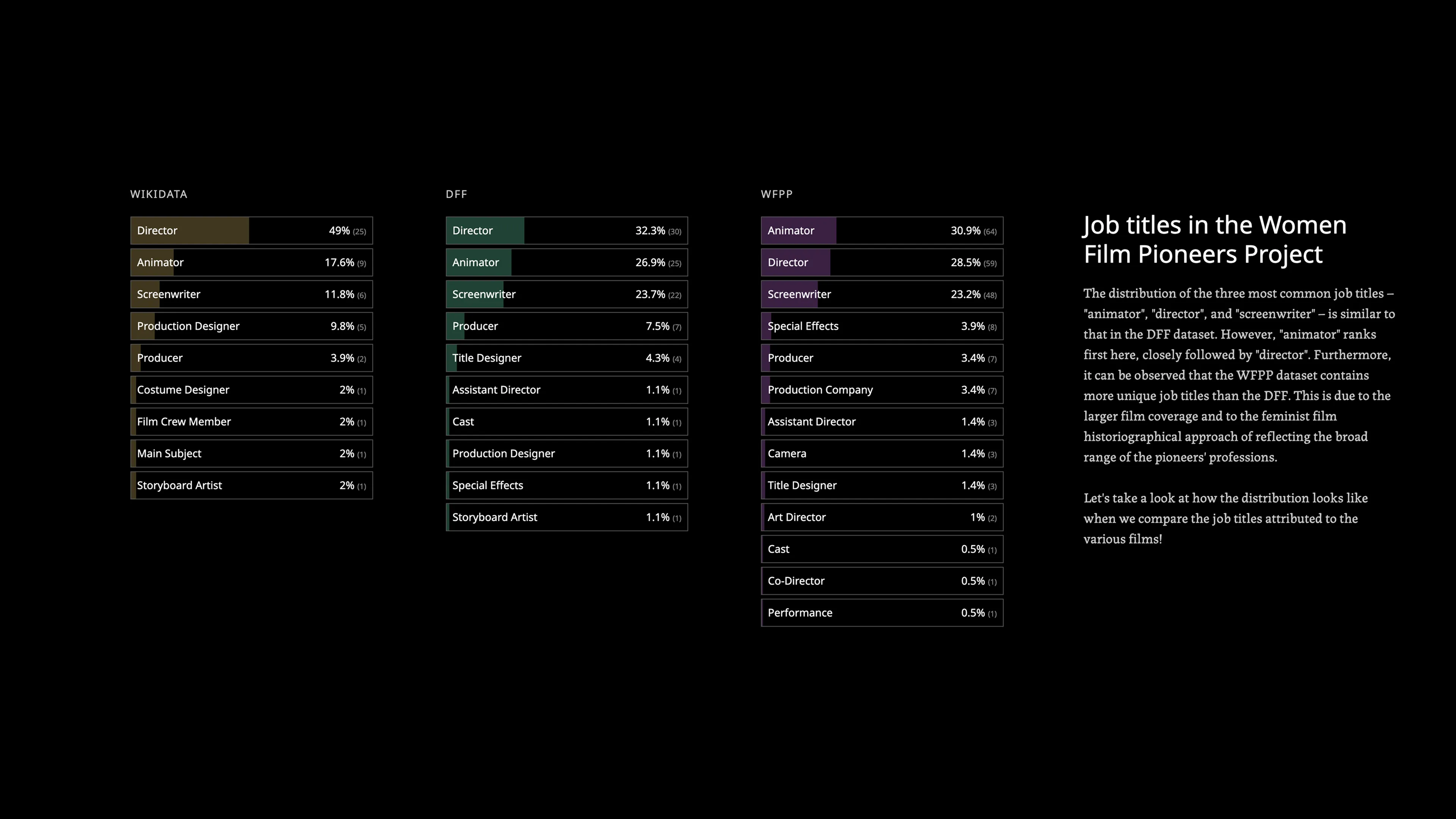
Placing all three datasets side by side reveals that the same person carries a different professional identity depending on which collection you consult. The discrepancy is not noise; it reflects different institutional priorities, categorization systems, and levels of completeness.
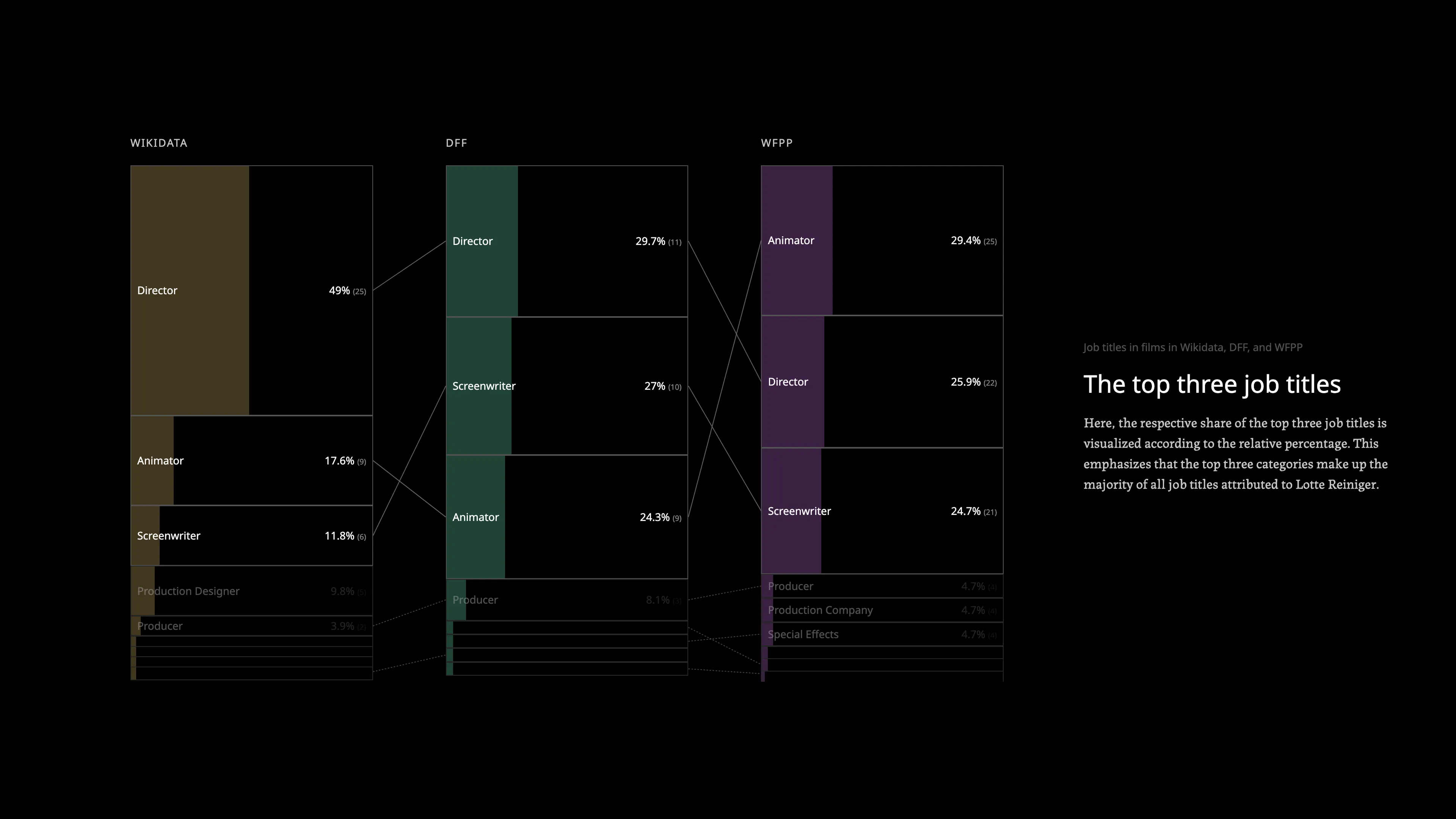
Bar chart — top three job titles highlighted
The final chart in the sequence isolates the three most frequent job titles across all datasets, giving the reader a clear comparative summary after working through the full complexity of the earlier views.

Process

  • Data exploration — reading the datasets before deciding the story

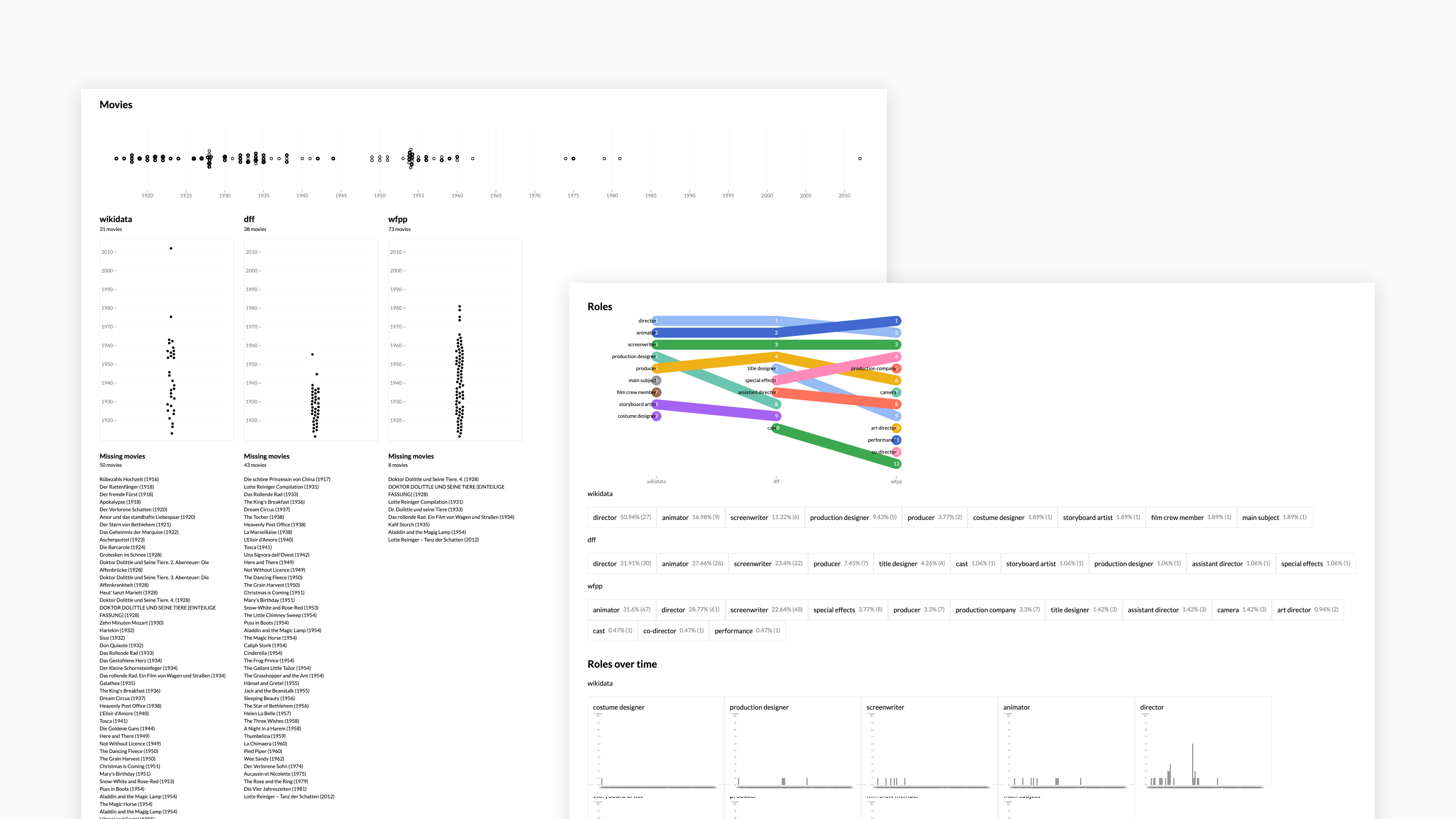
    Before any narrative work, the three datasets were explored in SvelteKit using Observable Plot. This phase was about developing a genuine understanding of what the data contained and what tensions it held: which job titles appeared where, which films were missing, where normalization was needed. The earlier visualization work done by the research group provided a foundation, but the exploration was done fresh to find a story that had not already been told.

  • Narrative concept — from data to scroll structure

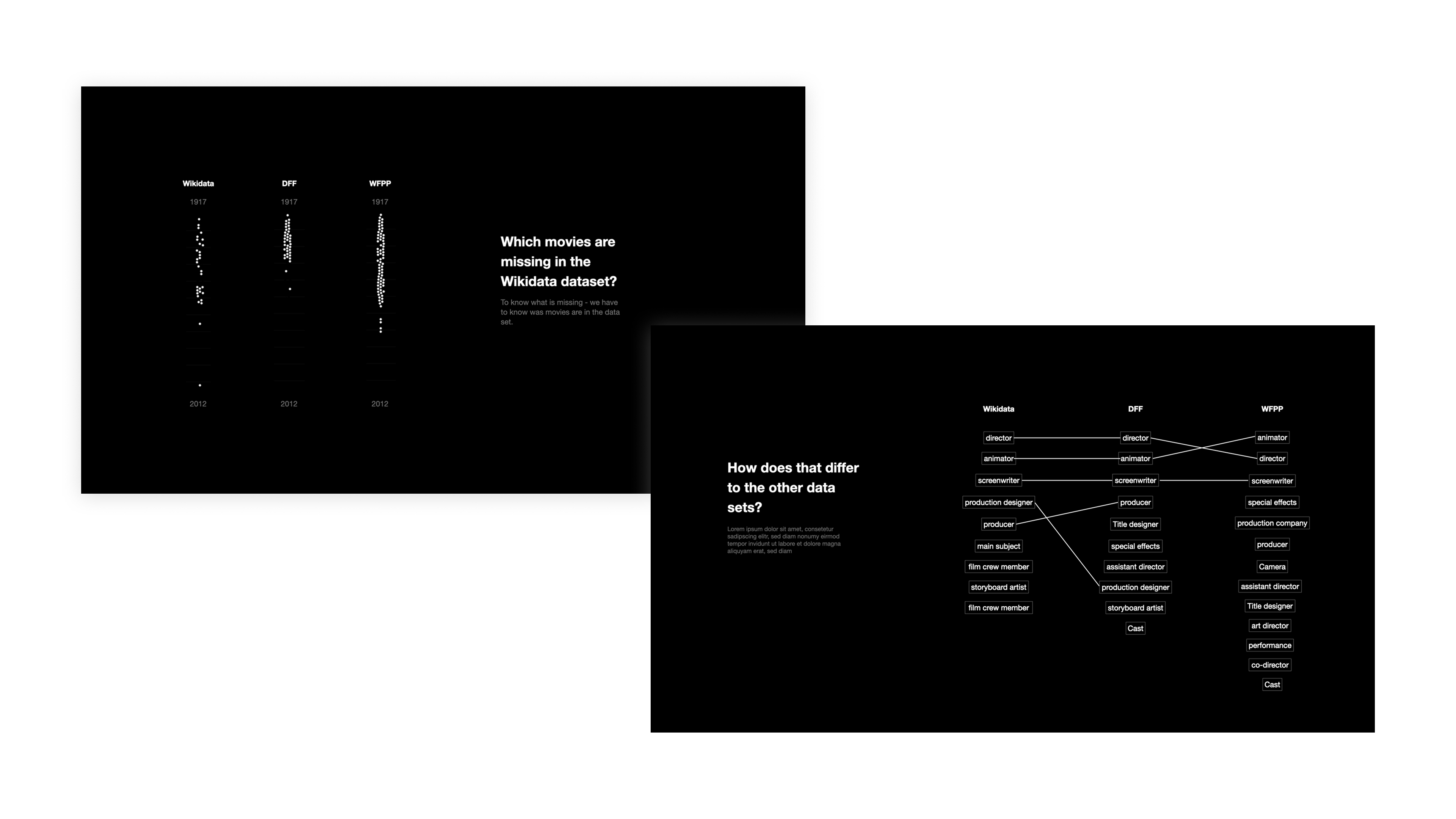
    A slide deck translated the data exploration into a proposed story structure, sequencing the three dataset questions into a scrollytelling arc. This became the tool for aligning with Sarah-Mai Dang on the narrative direction before any production began. The key editorial decisions, to focus on one person, show the art not just the metadata, and let absence do the argumentative work, were established in this phase.

  • Production — from rough concept to finished site

    The final site required building in stages: data normalization, Canvas animation, D3 chart components, and the SvelteKit architecture, with the full visual quality only visible close to launch. Working with a research partner who understood and trusted the iterative process made it possible to keep refining the work until it said what it needed to say.

    Impact

    Published research reaching the right audience at launch

    The project launched in May 2026 as the third and final data visualization output of the BMFTR Research Group DAVIF, funded by the German Federal Ministry of Research, Technology and Space. Within days of publication, Sarah-Mai Dang's LinkedIn post reached film studies professors, museum directors, archive heads, and digital humanities researchers across Europe and North America, including engagement from Lev Manovich, whose comment noted the rarity of a data visualization that asks critical questions about its own datasets rather than simply presenting them. The audience reaction confirmed the core editorial decision: showing Reiniger's art alongside the metadata analysis made the argument land for people who care about both film history and data practice.

    Project in numbers

    3
    Datasets cross-referenced
    79
    Films in the combined dataset

    Learnings

    Data visualization can hide as much as it reveals

    This project sharpened something that had been forming for a while: visualization is not a neutral act. By abstracting data into dots and bars, it is easy to make the thing being described less present, not more. The decision to show Reiniger's actual films, putting her art in front of readers before asking them to think about metadata, came from a discomfort with how much abstraction can distance audiences from what is actually at stake.

    Portrait of Christian Laesser

    Contact

    Do you need support for your next project?

    Time zone

    CET

    Current time

    Reply time

    2work days

    Your next project starts with a conversation. Not sure if your project is a good fit? Read the FAQ first, it might answer your question before we even talk.